

There are more than 1.2 billion people in Africa. 70% of this population is under the age of 30. Yet of this group, less than 10% have tertiary education. In less than 20 years, Africa will have the largest working age population in the world. This means a majority of the youth will be without education, skills, and jobs.
Several economic indicators, on the other hand, consider Africa as the next economic powerhouses. In 2015, 6 out of the world’s 13 fastest growing economies were in Africa.
Given the majority of Africa’s young population are undereducated, the questions NOLBED Foundation tries to answer through its work are:
- When Africa’s economy takes off, what role will Africans play?
- How can Africans help transform and sustain the continent?
NOLBED’s mission is simple – to empower the next generation of ethical leaders with the knowledge, skills, and passion needed to positively reconstruct their lives and communities.
Read more
https://www.indiegogo.com/projects/let-s-uplift-underprivileged-communities-in-africa#/
What we do
The NOLBED Program is dedicated to uplifting underprivileged communities by bridging the gap between their exceptionally-talented students and a quality education. Our goal is to give candidates the opportunity to attend top-tier colleges around the world on a full scholarship through our gap year program.
Thus, we identify underprivileged communities and target their brightest high school seniors and recent graduates. These students go through a carefully choreographed program that includes lectures and seminars on leadership and ethics, SAT preparation, college application guidance, mentorship, and volunteering activities.
Teaching civics through problem-solving:
An important component of our gap year curriculum includes experiential learning and critical thinking. “In Africa – as is true of many developing countries – the education system rewards students who can memorize course materials. So it becomes a challenge for these students if they are given a task that requires them to think critically,” explains Salia, the founder of NOLBED. To help develop these skills, NOLBED students are required to work on a project that directly solves, at least, one critical challenge in the community. Each student is required to volunteer at least 500 hours throughout the program.
This year’s community development projects:
The 2017 class has had tremendous success with its community development projects. One focused on increasing the utilization of the Aboabo Community Library. In three months, the students raised the number of visitors from 6.7% to more than 60%. The class achieved this remarkable success through social media campaigns, speaking engagements at neighboring schools and by establishing office hours in the library to help other students with homework. The 2017 class also launched the Abóta Initiative, an afterschool program that helps junior year high school students perform better on the national entrance exam. “Our belief is that helping these students attend quality high schools will accelerate their path toward higher education and will eventually break the cycle of poverty in their communities,” said Salia.
The Impact of our work:
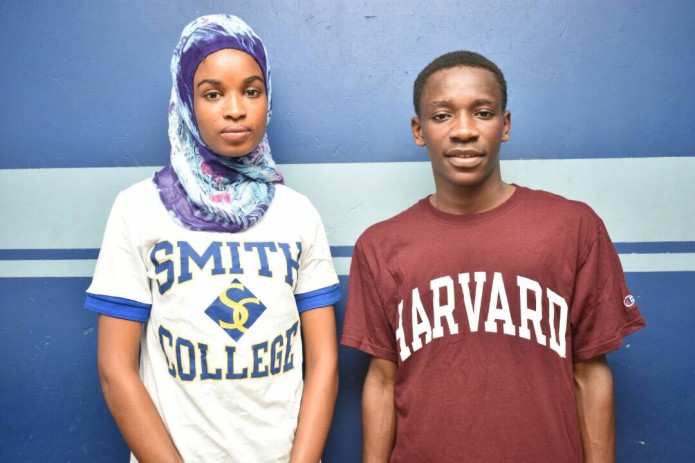
Wasila Yussif (left) and Augustine Bannerman (right)
Meet Wasila Yussif
Her single mother sells watermelons in the morning and sugarcanes in the evening. Her mother earns less than $1,500 annually, yet she did everything she could to allow Wasila graduate high school.
We selected Wasila into the Nolbed program not because of her academic achievement, but her grit and tenacity. Please visit our Facebook page via the link below or website to read Wasila’s story.
Wasila is going to Smith College this fall on full scholarship! This opportunity allows Wasila to break the circle of poverty in her family. This is projected to happen with, at most, two years’ salary after graduation.
Meet Augustine Bannerman
He writes: “I got home that day like a mad dog. Jumping, shouting and yelling with so much gratitude. Screaming my mother’s name: “Mama, I got into Harvard.” She squealed with praises. Clapping vigorously for a while, quickly turned around and asked “what’s Harvard?” “I’ll be going to the best college in the world on a full scholarship. It’s in America!” I explained. I still believe she has no idea what that really means.
My parents have never been to school, and I’ll be the first person in my family to attend college. My mom is a hairdresser in Aboabo, a slum community in Kumasi, Ghana, and my dad sells vegetables. They’re poor, financially. They couldn’t afford the cost of local university after I graduated from Opoku Ware SHS.
Consequently, I couldn’t have made it this far without the help of others. People believed in me. Family, teachers, friends, and strangers. They saw my potential; felt my passion; and provided the support and guidance I needed.
Thanks to them, my dream of becoming a surgeon begins at Harvard this fall!”
In summary, the opportunities we present to our beneficiaries allow them to uplift their entire family out of poverty within a short time after graduation.
Meeting our challenges
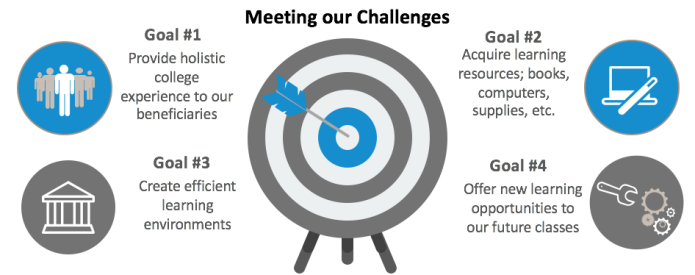
So far this year, NOLBED has placed 100% of its 2017 class in college. Collectively, the students received more than $700,000 in scholarships. The organization has achieved impressive momentum, but it’s looking for more support to help ensure it can continue to provide holistic college experience to its beneficiaries, acquire additional learning resources such as books and computers, and offer new learning opportunities for its future classes.
Let’s transform lives. Together!
Read more
—
https://www.indiegogo.com/projects/let-s-uplift-underprivileged-communities-in-africa#/